TOP 10 SEO Agencies in Ukraine in 2026

The best SEO agencies help businesses capture targeted demand from Google, generate leads, and increase sales through systematic work on the website, content, analytics, and user experience. For business owners, marketers, and e-commerce teams, the key question is this: can the contractor connect website promotion to your business economics rather than simply send ranking reports?
Choosing the wrong provider is costly. A website may go months without noticeable growth, accumulate technical issues, lose organic traffic after risky actions, or receive content that does not help generate sales. That is why, when choosing an SEO company, you should evaluate not the loudness of its claims but its processes, case studies, team, contract, and data accessibility.
Key takeaways
- There is no single official ranking of SEO agencies - any shortlist must be validated against your business goals.
- A strong agency ties SEO to leads, sales, and revenue, not just keyword positions.
- Key criteria: relevant case studies, an initial audit with a roadmap, white-hat methodology, a transparent contract, and access to data.
- In 2026, experience with AI search (GEO/AEO), Core Web Vitals, and E-E-A-T is critical.
- Send the same brief to 3-5 agencies and compare their first-90-days plans - the best way to choose a partner.
There is no single official ranking that can objectively identify the best SEO agencies in Ukraine for every business. Companies differ in scale, specialization, geography, and range of services. Below is an indicative list of notable market players for initial research. It does not replace a briefing, case study review, or commercial proposal assessment.
| No. | Agency | Specialization | Who it is suitable for and what to clarify |
|---|---|---|---|
| 1 | SEOGeeks | An agency providing comprehensive SEO, GEO/AEO promotion, and SEO support during development. | Suitable for projects that prioritize leads, analytics, UX recommendations, and work across the Ukrainian, European, US, and Canadian markets. Our team has delivered more than 200 projects and has been operating for over 7 years. |
| 2 | Promodo | A well-known digital company with experience in e-commerce and integrated marketing. | Worth considering if you need a broad range of marketing expertise from one provider. |
| 3 | Elit-Web | An agency working with SEO, PPC advertising, and other digital marketing channels. | When choosing, clarify the composition of the team assigned specifically to SEO tasks. |
| 4 | WEZOM | A company with a strong focus on development and digital products. | May be relevant for businesses that need to develop their website and search promotion at the same time. |
| 5 | Livepage | A team known for SEO and content marketing work. | It is worth adding to the shortlist for projects where content plays a significant role. |
| 6 | LuxSite | An SEO company with experience promoting commercial websites. | It is useful to request case studies in your niche and target market. |
| 7 | Idea Digital Agency | A digital agency with an SEO division and experience using performance marketing tools. | Suitable for comparing integrated approaches. |
| 8 | UAMASTER | A large digital agency working with different advertising channels. | For an SEO project, it is important to clarify the management format and depth of technical expertise. |
| 9 | Panem Agency | An agency worth researching when looking for a provider for search promotion and integrated digital marketing. | - |
| 10 | Site24 | A team working with website development and promotion. | Before getting started, it is useful to review examples of projects of a similar scale. |
This list of top SEO companies is useful as a starting point. Select 3–5 candidates, send them the same brief, and compare their responses by scope of work, implementation timelines, KPIs, and contract terms.
What sets the best SEO agencies apart from regular contractors
A strong SEO agency starts with business goals: which products or services generate profit, which markets matter, where leads are being lost, and which pages can attract search demand. Keyword rankings remain a useful metric, but they do not pay salaries or suppliers on their own.
High-quality SEO connects organic traffic with conversions, leads, average order value, and revenue. For an online store, this may mean sales from category and product pages. For B2B, it may involve quote requests, calls, or requests for proposals. For SaaS, it means registrations, demos, and paid subscriptions.
“At SEOGeeks, we view SEO as work at the intersection of marketing, development, content, and analytics. Sometimes growth is limited by page indexing, sometimes by a weak catalog structure, and sometimes by a lead form that is inconvenient to use on a phone. There is no universal set of tasks: an SEO strategy must account for the website’s starting point and the real competition in Google search results.”
What tasks an SEO agency solves
An SEO agency conducts a technical website audit, analyzes demand and competitors, develops a semantic keyword core, improves page structure, and helps make content useful for visitors. A typical scope of work includes checking indexing, loading speed, the mobile version, duplicate pages, redirects, structured data, catalog filters, and errors in Google Search Console.
Then the commercial part begins. Specialists determine which landing pages are needed for product categories, services, cities, informational queries, and comparisons. For an online store, this may involve a separate structure for brands, product types, and selection parameters. For a clinic, it may include service pages, doctor profiles, pricing, and answers to frequently asked questions.
SEO promotion services also typically include:
- content planning and creation;
- on-page optimization;
- work on external mentions and the backlink profile using white-hat methods;
- conversion tracking setup;
- user behavior analysis;
- recommendations on UX/UI, forms, CTAs, and commercial factors;
- regular performance evaluation and plan adjustments.
The agency’s task is to explain which actions have the highest priority impact, who will perform them, and how the changes will be measured.
When a business needs an external SEO provider
An external SEO provider is useful for companies that do not have an in-house team or lack expertise in certain areas. This is particularly noticeable for technically complex websites, e-commerce stores with thousands of URLs, B2B projects with a long sales cycle, SaaS products, and expansion into European, US, or Canadian markets.
An agency helps when a website is being prepared for launch or redesign. Fixing URL logic, internal linking, meta tag templates, and indexing during development is usually easier than restoring visibility after launch. Another scenario is a drop in organic traffic, domain migration issues, or the need for an independent SEO audit of the current team’s work.
However, it is not always advisable to outsource every decision. At large companies, an in-house marketer, editor, or SEO specialist knows the product and customers better. In this model, the agency handles analytics, technical SEO, international SEO, link building, or auditing, while the client team approves implementation faster. This often produces more sustainable results than a contractor working in an information vacuum.
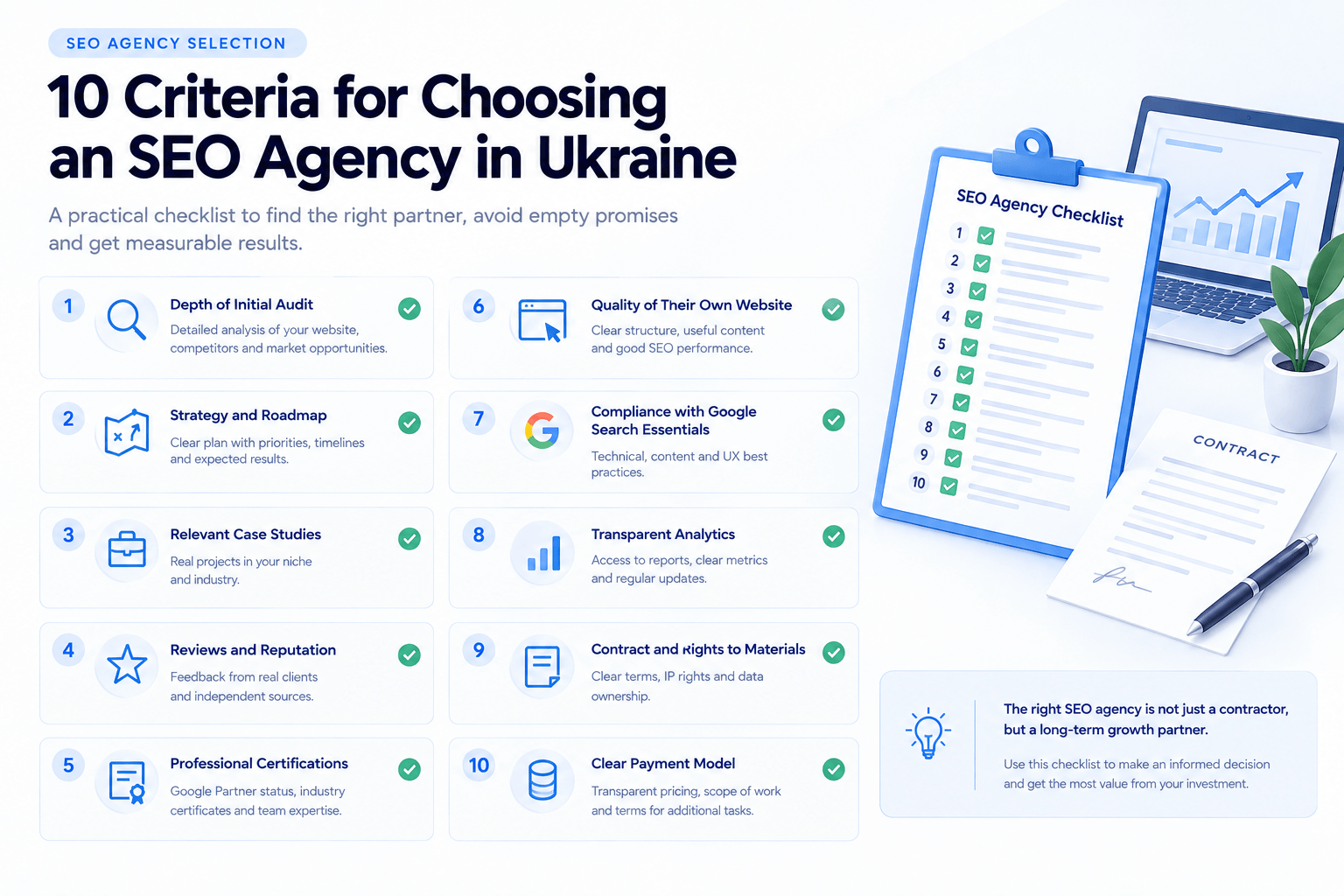
10 criteria for choosing an SEO agency in Ukraine
An SEO company selection checklist is needed to ensure that discussions with a contractor do not come down to promises of growth and one final estimate figure. A good commercial proposal usually includes a monthly task list, specialist roles, expected checkpoints, the cost of additional tasks, and a list of required access permissions.
It is convenient to keep these ten criteria in mind:
- depth of the initial audit;
- strategy and roadmap;
- relevant case studies;
- reviews and reputation;
- professional validation;
- quality of the agency’s own website;
- compliance with Google Search Essentials;
- transparent analytics;
- contract and rights to materials;
- a clear payment model.
Initial audit, strategy, and roadmap
The initial audit should answer practical questions: why the website is losing traffic, which pages generate leads, what prevents indexing, and which changes will have the fastest impact. A 100-page document without priorities is of little help to a business team.
Ask the agency: “What are the first three issues you will check, and what will you need from our development team?” The response should include specific areas: technical condition, demand, website structure, commercial factors, content, competitors, and analytics.
After the audit, you need a roadmap for 3, 6, and 12 months. It should define stages, responsible parties, dependencies on the client, and KPIs. For example, technical tasks may be ready for implementation within two weeks, but their implementation by developers can sometimes take a month or a quarter. This risk should be identified in advance; otherwise, the plan will remain merely a presentation.
Case studies, reviews, awards, and the agency’s own website
Ask to see case studies with baseline conditions: what the website looked like before the start, how long the collaboration lasted, which pages were improved, and how results were measured. A screenshot of a nice-looking chart without a period, data source, or context does not allow you to assess the quality of work.
A useful case study shows the growth of organic traffic, conversions, or revenue and describes the changes made. If data is covered by a confidentiality agreement, the contractor can still explain the work logic and show an anonymized reporting example.
Reviews on professional platforms and participation in industry rankings complement the picture. They confirm the company’s market presence, but they do not reveal who will manage your project. Clarify whether the manager works with dozens of clients and who is responsible for technical decisions.
Also review the agency’s website: its mobile version, speed, service structure, materials, and clarity of contact information. No website is perfect, but an agency’s own resource demonstrates the team’s attitude toward core SEO and UX practices.
White-Hat methodology, analytics, and reporting
Safe website promotion is based on Google Search Essentials recommendations, improving page quality, and the natural development of the backlink profile. The agency should clearly explain where links come from, what materials are created, and what risks the team sees.
Ask a direct question: “Which practices do you refuse to use on principle?” A competent contractor does not hide its methodology behind claims of “secret technologies.” It explains donor website evaluation, content quality, technical standards, and change control on the website.
The client needs access to Google Analytics, Google Search Console, advertising accounts, and working documents within agreed permissions. Reporting should reflect changes in priority keyword clusters, non-branded traffic, conversions, lead quality, and completed tasks. For businesses with repeat sales, it is useful to discuss LTV - customer lifetime value.
Contract, SLA, rights, and payment model
The contract defines the range of services, reporting frequency, approval process, and the parties’ responsibilities. An important point of potential dispute is the ownership of prepared copy, design, keyword research tables, and placed links after termination. It is better to assign these rights to the client or define transfer conditions in advance.
The SLA establishes response times for requests and critical issues. It is also worth agreeing on how many revision rounds are included, who approves materials, and what happens if the client delays access provision or task implementation.
The market uses three main payment formats. A monthly retainer is suitable for systematic promotion with ongoing content, technical, and analytics tasks. A fixed-price project is convenient for an audit, migration, or strategy preparation. An hourly model works well for consulting and complex one-off tasks. You should compare the scope of work and expected team workload, not only the price in the “SEO” line.
SEO Agency rankings in Ukraine: how to read lists and compare companies
An SEO agency ranking in Ukraine helps quickly identify companies worth learning more about. Use directories as a filter, then move on to independent research: study specialization, case studies, service offerings, communication language, and team availability.
| Comparison criterion | What to check | Why it matters |
|---|---|---|
| Specialization | e-commerce, B2B, SaaS, local business, international markets | Experience should match the website’s task |
| Case studies | Initial data, period, actions, metrics | Show the quality of the process |
| Team | Who handles strategy, technical work, content, and links | Determines the depth of work |
| KPIs | Traffic, leads, sales, visibility, technical metrics | Removes vague expectations |
| Communication | Call frequency, response times, access permissions | Affects implementation speed |
| Estimate | What is included in the package and what is charged separately | Protects against unexpected expenses |
Why a ranking position does not equal the best choice
Rankings are built using different methodologies. Some consider reviews, while others focus on team size, brand recognition, participation in competitions, or the range of services. These indicators are useful, but they do not show whether an agency can handle your website, market, and competitors.
For example, a large team may be convenient for a major online store with several language versions. A smaller agency can sometimes provide closer involvement from a senior specialist. The choice depends on the task, budget, and speed of decision-making on the client side.
Review at least two sources: the contractor’s own website and an independent SEO agency directory. Then hold the same meetings with all candidates. This makes it easier to see differences in approach rather than differences in presentations.
Which agencies to add to the shortlist
For a shortlist, you can consider us (SEOGeeks), as well as Promodo, Elit-Web, WEZOM, and Livepage. These are examples of notable companies with different positioning, from integrated digital marketing to SEO, development, content, and analytics work.
If your project is related to healthcare, finance, cryptocurrency, or pharmaceuticals, request experience specifically in regulated industries. In these niches, fact-checking, expert content, legal restrictions, and careful wording are especially important.
For local businesses, Google Business Profile, service pages, and demand geography matter. International projects also require hreflang, localization, separate content versions, market-specific considerations, and competition in English or another language. These details are best discussed before signing a contract.
What to compare at the first meeting with agencies
During the call, ask to see an example of a plan for the first 90 days. It usually includes collecting access permissions, an audit, demand analysis, technical specifications, priority fixes, a content plan, and measurement setup.
Also clarify:
- who will work on the project and how many hours are allocated;
- which KPIs the team considers realistic;
- which tasks remain the client’s responsibility;
- what the report and live dashboard look like;
- what is included in the retainer;
- how much additional development, copywriting, and links cost;
- how website changes are recorded;
- what scenario is provided for contract termination.
Key SEO trends in Ukraine in 2026
In 2026, SEO in Ukraine increasingly depends on website quality as a product. Google evaluates whether pages are accessible for crawling, whether materials are useful, whether they match user intent, whether the brand is trustworthy, and whether interacting with the site is convenient.
AI search is changing how people obtain information. A user may see a generative response in search results or turn to ChatGPT, Gemini, Claude, and Perplexity. This does not eliminate traditional SEO: search and generative systems still rely on clear, technically accessible, and trustworthy sources.
A separate direction is called GEO or AEO. GEO stands for Generative Engine Optimization, which involves optimizing a brand’s and its materials’ presence in generative answers. AEO stands for Answer Engine Optimization, which means preparing content for systems that answer questions. Clear structure, expertise, verifiable facts, entities, service pages, FAQs, and straightforward answers to real customer questions are important here.
For Ukrainian companies, multilingual websites, local SEO, mobile optimization, work on product categories, and improving commercial factors also remain relevant. AI tools speed up analysis and draft preparation, but they do not replace editing, fact-checking, or business understanding.
How to choose an SEO agency partner in the AI Search Era
When choosing a contractor in 2026, ask how it connects traditional SEO, content marketing, and GEO promotion. The agency should be able to explain which pages will become sources of expert information, how material accuracy will be checked, and how visibility changes will be measured.
GEO does not mean guaranteed mentions of a company in ChatGPT or Gemini answers. Generative systems change their answers, use different sources, and do not give businesses full control over the outcome. The practical task is different: make the website an understandable source for people, search engines, and AI platforms.
At SEOGeeks, we include GEO/AEO in the overall SEO strategy. We review answer structure, brand and product entities, author expertise, commercial pages, technical content accessibility, and topical coverage. For e-commerce, this may include buying guides, comparisons, and answers about product characteristics. For B2B, it may include solution pages, case studies, documentation, and plain-language explanations of complex services.
A good question for a prospective contractor is: “What changes will you recommend for AI search, and how will you distinguish useful work from simply adding FAQs for formality?” If the response is limited to mass text generation, it is worth continuing your search. Quality work requires editorial review, expert comments, current data, and technical discipline.
Need an SEO growth plan for your business?
Book a free consultation: we'll review your website, market, and competitors and propose a strategy for the first 90 days.
How much does website SEO promotion cost in Ukraine
It is impossible to honestly name a single price for SEO services in Ukraine without reviewing the website and objectives. The budget for an online store with several thousand product pages will differ from the budget for a local service company. International promotion requires separate work with languages, markets, competitors, and content.
In a well-founded estimate, an agency shows where funds are allocated: audit, technical specifications, analytics, content, links, consulting, management, and strategic work. If a proposal contains only one line, “SEO promotion,” without a breakdown, it is impossible to assess the quality of future services.
What determines an SEO budget
The cost of website promotion is affected by technical condition, number of pages, competition in Google search results, approval speed, and the client team’s capabilities. A website after a failed migration or with a chaotic structure often first requires recovery work.
The budget increases with multiple language versions, target regions, a large product range, the need for regular content, complex analytics integrations, and separate brand reputation work. Local SEO requires its own set of tasks: business listings, district or city pages, reviews, and consistent contact details.
AI promotion also requires resources when it involves reworking the knowledge base, expert materials, and answer structure. Adding several template paragraphs to a website does not create sustainable visibility.
Retainer, project work, or hourly payment
A monthly retainer is usually chosen for ongoing SEO promotion. It makes it possible to plan tasks, content production, technical improvements, and regular analysis. Its weak point is an opaque package where the client does not understand the scope of work.
Project-based payment is suitable for an SEO audit, migration, keyword research development, or strategy preparation. Here, it is important to describe the result in advance: for example, an audit with prioritized tasks, technical requirements, and a call with the development team.
Hourly payment is convenient for consulting, release reviews, complex analysis, or supporting an in-house team. It requires time tracking and a clear rate. Average fixed market rates vary greatly, so it is more useful to compare hours, specialist roles, and a list of specific deliverables.
How to assess the return on SEO Investments
ROI is calculated through business metrics. First, determine how many organic visits come to commercial pages, what share of users submits an inquiry or purchases a product, and what the average order value and margin are. For subscription models and repeat sales, also consider LTV.
A simple forecast is built using scenarios. For example, a company estimates the potential increase in visits to priority pages, applies its current conversion rate and average margin, and then checks what needs to happen to make that scenario realistic: new pages, technical improvements, a better offer, or a stronger brand.
An agency should not promise a fixed ROI before conducting a complete analysis. However, it can show assumptions, risks, and scenario ranges so that the business makes a decision based on logic rather than belief in an attractive number.
How work with an SEO agency is organized after launch
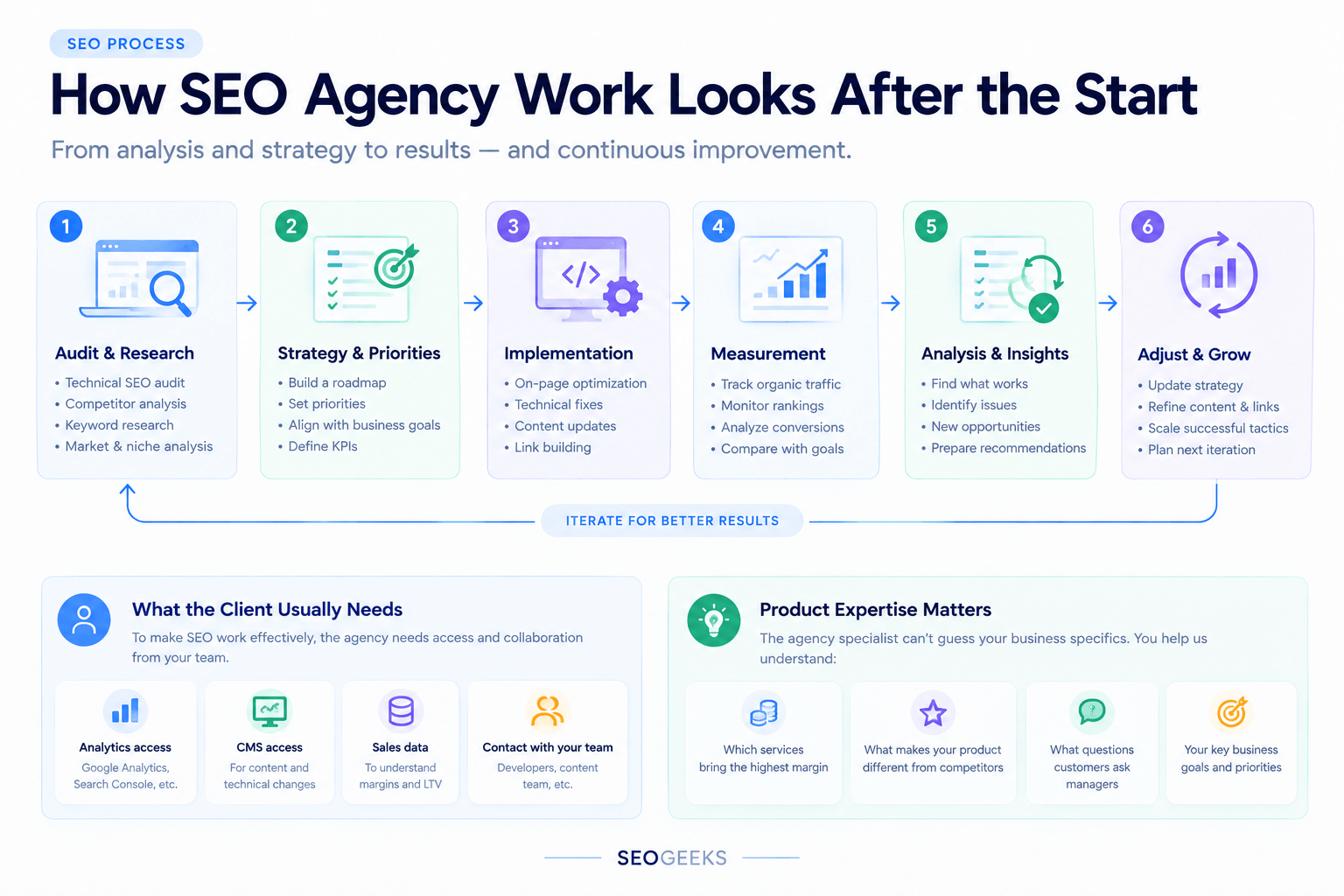
SEO promotion develops iteratively. After the start, the team receives access permissions, studies the product, identifies technical and commercial limitations, sets priorities, implements changes, and evaluates the response of organic traffic and conversions.
On the client side, access to analytics, CMS, sales data, and contact with developers or the content team are usually required. Product expertise is also important: an agency specialist cannot guess independently which services generate the highest margin, how a product differs from alternatives, or what questions customers ask sales managers.
The first 30–90 days: audit and priorities
During the first weeks, the team gathers data: access to Google Analytics and Google Search Console, website change history, a list of priority products or services, CRM data, and market information. Then a technical and commercial audit is conducted.
Within the first 30 days, critical errors are usually identified: pages blocked from indexing, incorrect redirects, duplicates, canonical URL issues, slow loading, and mobile version errors. Demand and competitors are analyzed in parallel.
By days 60–90, the client should have an approved work list: which tasks can be implemented quickly, what requires development, which landing pages are being prepared, how content will change, and what will be measured. In our projects, the first results are usually noticeable starting from the third month, but timelines depend on the niche, implementation volume, and website condition.
Which KPIs to agree on before launch
KPIs should be selected based on the project goal. For an online store, this may include growth in organic visits to categories, add-to-cart actions, transactions, and revenue. For services, it may include leads, calls, cost per lead, and inquiry quality. For B2B, it is important to consider deals that have passed qualification rather than just the number of completed forms.
Useful SEO KPIs include:
- visibility for priority keyword groups;
- non-branded organic traffic;
- the number and quality of leads;
- landing page conversion rate;
- revenue or margin income from organic traffic;
- website indexability and technical health;
- implementation speed of approved tasks.
Rankings can remain in the report, but they should not be the only goal. One high-volume keyword can sometimes bring less business than a dozen precise commercial queries.
What clear reporting should look like
A useful report answers four questions: what the team did, how metrics changed, why the changes occurred, and which actions are planned next. It should include both positive changes and issues that require resolution from the client side.
For our clients, we can set up a live dashboard in Looker Studio. It allows you to review organic traffic, conversions, and key metric trends at any time without waiting for a monthly presentation. At the same time, the dashboard itself does not replace a specialist’s commentary: a chart will not explain the impact of seasonality, a release, or an implementation delay.
A good practice is a monthly call to review results and plan the next period. If a technical task has remained unresolved for two months, it should be raised as a separate risk rather than hidden at the end of a PDF.
SEOGeeks case study: what evidence of expertise is worth checking
When choosing an SEO company, it is important to separate verifiable facts from advertising claims. You can request project examples, reporting structure, methodology descriptions, and analytics workflow details from us. Over more than 7 years of work, our team has completed over 200 projects, and we record the first results starting from the third month.
Check how an agency formulates its achievements. A proper case study shows context: the niche, period, initial limitations, completed tasks, and metrics affected by the work. Access to confidential client data is usually restricted, so an agency must honor agreements and not publish sensitive information without permission.
For comparison, you can look at Aweb, a company with extensive experience: it was founded in 2006, states that it has completed more than 3,100 projects, and in some case studies reports organic traffic growth of 200–400% over six months. Such figures cannot be applied to every website. They should be checked against the original case study source, measurement period, traffic channel, and list of completed work.
Case study results and their verifiability
Ask where the metric comes from: Google Analytics, Google Search Console, CRM, or an internal analytics system. Clarify the comparison period, seasonality, and the presence of paid advertising activity. Traffic growth after a redesign, product range expansion, or advertising launch may have several causes.
A good case study includes the original problem. For example, an online store had poorly indexed filters, duplicate pages, and insufficient coverage of commercial category queries. After fixing templates, building the structure, and launching useful landing pages, traffic began to grow. This logic is more valuable than an abstract claim of a “breakthrough.”
How to prepare for selection and start a partnership
Start with a short brief for all candidates. Describe the website, markets, product, audience, target services or categories, current lead sources, available analytics data, and approximate budget. Add a business objective for the next 6–12 months: growing sales of a specific category, entering a new region, reducing dependence on paid advertising, or preparing the website for launch.
Next, hold identical briefings, request an audit or preliminary proposal, and compare the scope of work. If proposals differ significantly, ask the teams to explain their priorities. Sometimes one agency plans deep technical work while another includes only content. Formally, both proposals are called SEO, but in essence they are different services.
What to prepare before the first consultation
Prepare a link to the website and a list of markets, a short product description, a target audience profile, a list of competitors and priority pages. Google Analytics, Google Search Console, CRM data, and information about average cost per lead, average order value, and margin are useful.
If the website is under development, attach prototypes, a page map, technical specifications, and the launch date. For an online store, add data on categories, product range, and inventory. This will allow the SEO provider to propose a realistic plan.
Questions to ask before signing a contract
Before signing the contract, clarify who is included in the team, which tasks will be completed in the first quarter, and which access permissions are needed. Ask about KPIs, risks, approval timelines, rights to content and link materials, and the termination procedure.
Also ask to see an example of a monthly report and task tracking sheet. If the agency offers a package, request a breakdown: how many materials, technical specifications, consulting hours, and link placements are included. This reduces the risk of different interpretations of the service scope after the start.
Checklist: how to choose an SEO agency for your business needs
Before making your final choice, check these ten points:
- SEO goals are linked to leads, sales, or another measurable outcome
- The target geography and promotion languages match your markets
- The agency has relevant experience in your niche
- The initial audit includes technical SEO, demand, competitors, and commercial factors
- The roadmap is planned for 3, 6, and 12 months
- The methodology complies with Google Search Essentials requirements
- You will receive access to data and clear analytics
- The team has explained specialist roles in advance
- The contract defines rights, SLA, scope of work, and exit procedures
- The estimate clearly states what exactly you are paying for
The next step: send the same package of materials to three selected agencies - a website link, a list of priority products or services, markets, current lead data, and an approximate budget. Then compare their first 90-day plans. If you would like to discuss the task with our SEO specialist, choose an SEO Specialist Consultation.
FAQ
Answers to frequently asked questions
Choose an agency with proven e-commerce experience and an understanding of category structures, filters, product pages, and sales analytics. Request a work plan for the first 90 days, case studies of similar stores, and a detailed estimate breakdown.
You can trust a ranking as a source of candidates for initial selection. Then review case studies, specialization, team, approach to KPIs, and contract terms. A high position in a directory does not prove compatibility with your project.
The first changes may be noticeable starting from the third month, especially after fixing critical technical errors. Sustainable growth depends on competition, website condition, task implementation speed, demand, and scope of work.
Request an audit, roadmap, reporting examples, and case studies with a clear measurement methodology. Make sure the agency uses white-hat methods, works with analytics, and explains its approach to SEO and AI search without promising guaranteed mentions.
SEO is effective for niches with steady search demand: e-commerce, services, B2B, manufacturing, healthcare, tourism, IT, and local businesses. Results depend on demand, competition, website quality, and the ability to convert visits into inquiries.
Basic tasks can be handled independently, especially for a small website. An agency is useful for technically complex projects, high competition, entering new markets, or a lack of internal team resources. A hybrid model often works well.
SEO companies can guarantee the scope of work, reporting transparency, compliance with agreed communication timelines, and access to data. Guaranteeing specific rankings, traffic, or revenue is inappropriate because search results are influenced by competition, algorithms, and client actions.
A strong agency conducts a thorough audit, prepares a strategy, shows verifiable case studies, follows Google guidelines, provides access to analytics, and defines terms in the contract. Relevant experience and clear communication are also important.
An agency usually provides a team: an SEO specialist, analyst, content expert, link builder, and manager. A freelancer may be a strong expert for a specific task, but their resources and range of competencies are usually limited to one person.
AI search increases the importance of high-quality content, technical accessibility, expertise, and clear website structure. Choose a contractor that can work with GEO/AEO, explains its methodology, and does not promise guaranteed inclusion in ChatGPT, Gemini, or other system responses.
A large agency may allocate more specialists and handle complex tasks, but a project can sometimes pass through several layers of management. A smaller company often provides more direct access to senior experts. Compare the specific team, specialist workload, processes, and response speed.

Article author
Dmitry Millier
SEO Specialist
IT | Medical | Service websites
Hello, my name is Dmitry, and I am an SEO specialist with experience working in Western markets, primarily the US, Canada, and Europe. For several years, I have been working on projects in complex niches such as medicine, astrology, IT/dev products, and work and travel.