How Much Does SEO Cost and What Determines the Price

How Much Does Website Promotion Cost: The Short Answer
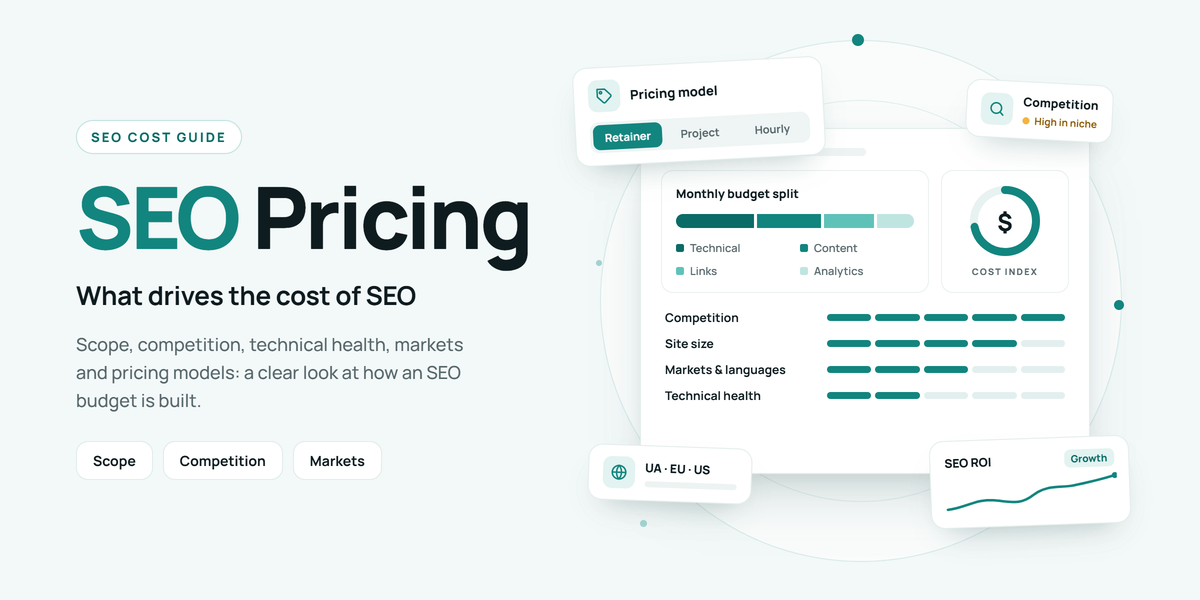
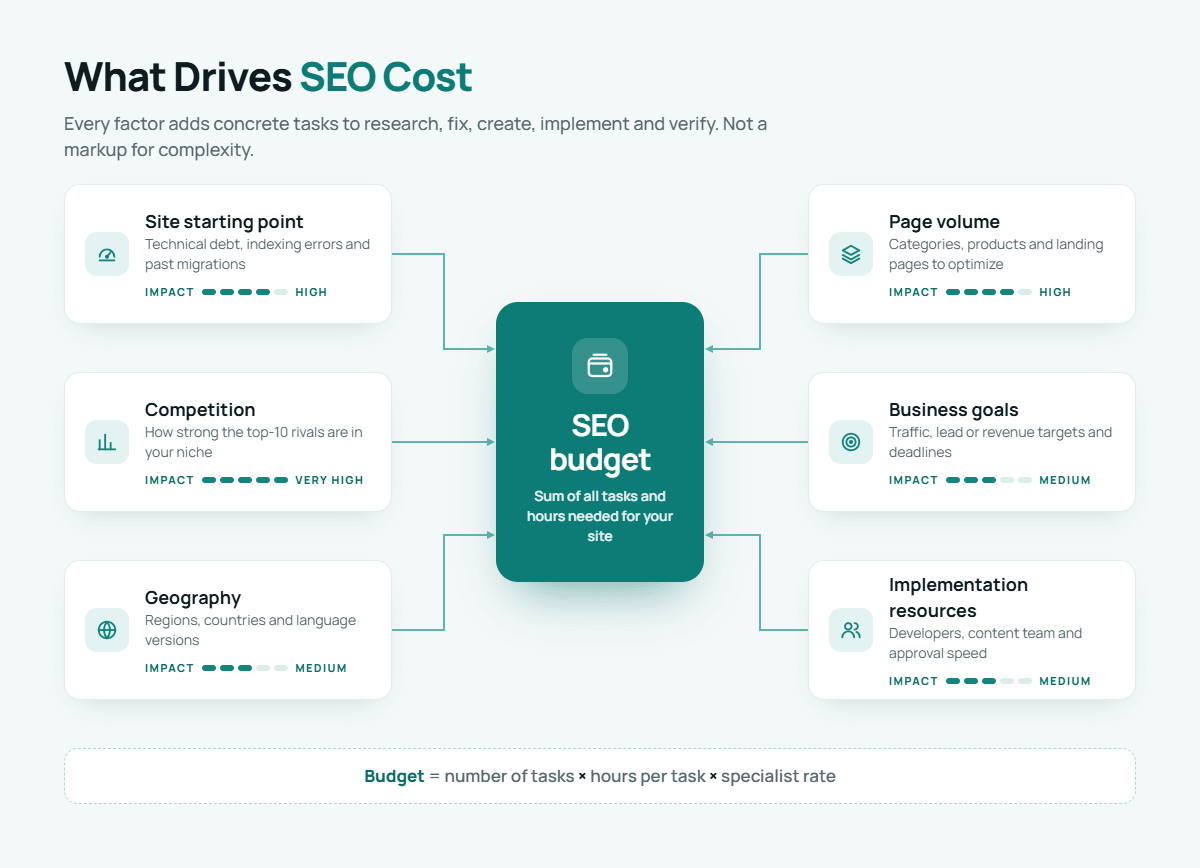
The cost of SEO for a website is calculated based on the scope of tasks required for a specific business. The budget is affected by the website’s technical condition, competition in the niche, geography, the number of priority pages, lead or sales goals, and the speed at which recommendations are implemented.
For example, two companies may offer the same service: window installation. But the first operates in one city, has 15 pages, and a clear structure. The second sells windows in five regions, maintains a catalog of profiles and fittings, uses an outdated CMS, and receives inquiries through forms, calls, and messaging apps. Formally, both need SEO, but the scope of work will differ.
The monthly cost of SEO usually includes analytics, keyword research, structure improvements, technical specifications, landing page optimization, indexation monitoring, competitor analysis, and reporting. Development, design, copywriting, photography, video production, subscriptions to specialized tools, and link placements may be charged separately.
A fixed offer without questions about the website may sometimes work for very standard tasks. However, businesses should clarify exactly what the provider will do during the first months and which services will remain outside the package. The price of SEO services matters, but by itself it does not indicate whether you will receive high-quality traffic and leads.
At SEOGeeks, we use white-hat methods and focus on leads, revenue, and clear analytics. When working with clients, we value access to data, transparency of implementation, and a realistic growth plan over promises of instant top rankings.
Key Takeaways
- A fair SEO price appears only after a diagnostic: the budget depends on website condition, competition, geography, the number of priority pages, and lead goals.
- The monthly fee usually covers analytics, keyword research, site structure, technical briefs, landing page optimization, and reporting; development, content, and links are often billed separately.
- The main payment models are retainer, pay-per-volume, hourly, project-based, and KPI-based; each model's risks should be fixed in the contract.
- Budgets for an online store, a service website, or promotion in the US and Europe differ several-fold - compare proposals by scope of work, not just the number.
- The first shifts usually appear from the third month; measure returns by leads, sales, and revenue, not just rankings.
What Determines the Cost of Website SEO
An SEO estimate is based on the amount of work involved: how much needs to be researched, fixed, created, implemented, and checked. A large catalog or a competitive niche is not a “complexity surcharge”-it increases the number of specific tasks.
Current Website Condition and Technical Debt
Before starting, it is useful to check whether Google can fully crawl and index the website. Errors in robots.txt, blocked important pages, duplicates, incorrect canonical URLs, slow loading speeds, or mobile version issues can undermine content work.
In practice, an initial audit often reveals accumulated technical debt. For example, an online store may have generated URLs for filter combinations for years and then ended up with thousands of low-value pages in the index. Another common scenario is that, after a redesign, meta tags disappear, redirects break, or page addresses change without a redirect map.
Such tasks require a developer’s involvement. An SEO specialist prepares the requirements, checks the implementation, and monitors the impact, but the programming workload itself is usually paid for separately. This is why the cost of SEO optimization during the initial stage can sometimes be higher than subsequent monthly support.
For a small service website, the initial scope may be limited to an audit, fixing critical errors, and preparing several landing pages. For a large e-commerce project, the technical work may take several iterations, especially if catalog templates, breadcrumbs, filters, or schema markup need improvement.
Competition, Region, and Search Demand
The cost of website search engine optimization depends on who the business competes with in search results and which audience it wants to reach. In a narrow local niche, several strong landing pages and a properly optimized business profile may sometimes be enough. In legal, medical, financial, construction, and e-commerce industries, there is usually more work involved.
The region also changes the picture. Promoting a service in one district of Kyiv, throughout Ukraine, in Poland, or in the United States requires different keyword research, local pages, language versions, and competitor analysis. Even a local service is not always simple: a dental clinic or appliance repair business in a large city may compete with dozens of companies that have been developing their websites and reviews for years.
A keyword semantic core is a list and grouping of search queries that potential customers use to find a product or service. The broader the demand, the more scenarios need to be covered with pages. A user may search for “buy cat food,” “hypoallergenic food,” “pet food delivery,” a specific brand, or a solution to a particular problem. One general catalog category rarely addresses all these intents.
The commercial value of a query also matters. For a business, it is more useful to track not just visibility growth, but visits to pages that generate inquiries, calls, orders, and repeat sales.
Website Type, Product Range, and Number of Pages
The number of URLs affects the workload, but SEO is not simply about mechanically processing every page one after another. Priority is given to pages with genuine demand, a clear commercial purpose, and the ability to provide users with a useful answer.
A service website usually has a limited number of areas, such as accounting support, sole proprietor registration, HR audits, and consultations. Here, it is necessary to build a clear service structure, add proof of expertise, make the path to submitting an inquiry convenient, and address regional needs.
An online store is more complex. It contains categories, subcategories, product pages, brands, filters, out-of-stock products, seasonal items, and pagination pages. If the assortment changes frequently, the SEO team needs to regularly check which pages are available for indexing, where duplicates appear, and how internal link equity is distributed.
A good structure helps the search engine understand the website and helps shoppers find products faster. Therefore, the cost of e-commerce SEO is usually higher than for a one-service landing page, although the final estimate depends on the platform’s condition and the owner’s goals.
Business Goals and the Speed of Implementing Recommendations
For SEO, it is important to agree in advance on what result the business considers useful. One company may need more leads for a particular service, another may want to increase sales of certain categories, and a third may be entering a new region or preparing a website for an international launch.
KPIs may include growth in targeted organic traffic, visibility for query groups, the number of leads, cost per lead, revenue from the organic channel, and the share of branded or non-branded demand. For an online store, it is useful to connect SEO data with orders and category margins.
Implementation speed has practical significance. If a technical specification sits with a developer for two months, improvements cannot appear in search. If new texts and expert materials are approved quickly, the team has more opportunities to test hypotheses and reallocate the budget toward effective areas.
We recommend appointing a client-side person responsible for access permissions, approvals, and data transfer. This reduces pauses between analysis, implementation, and result validation.
What Is Included in the Cost of SEO
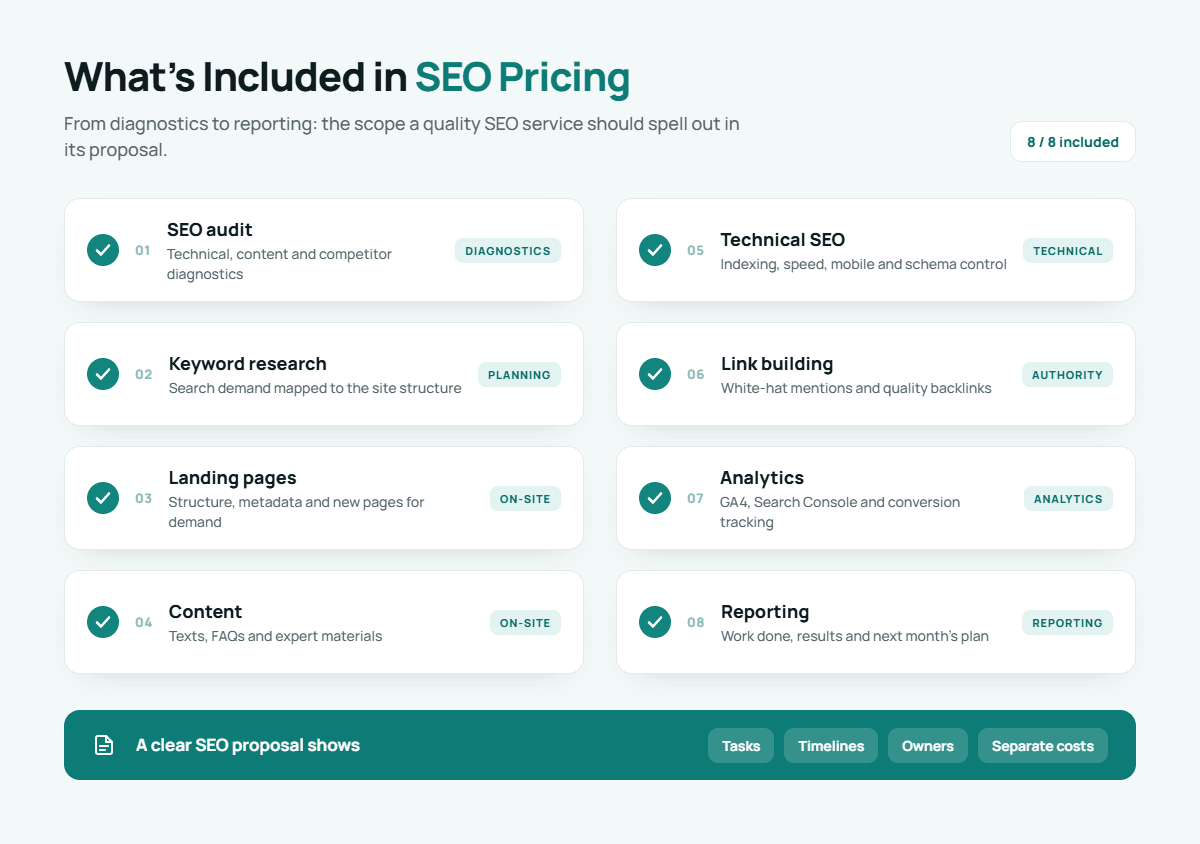
A quality SEO service includes diagnostics, planning, on-site work, technical factor monitoring, analytics, and clear reporting. The scope should be stated in the commercial proposal: the client needs to see the tasks, timelines, responsible specialists, and separate expenses.
SEO Audit, Strategy, and Keyword Research
An initial SEO audit shows which issues prevent a website from attracting traffic and conversions. It may include checks of indexation, structure, metadata, loading speed, mobile version, content, commercial factors, and competitor visibility.
After the audit, a plan is created: what needs to be fixed first, which pages need improvement, which areas should be expanded, and which metrics should be tracked. This is a working document, not a list of terms for a report.
Keyword research helps identify the language used by the audience. The specialist collects queries, removes irrelevant wording, groups them by intent, and maps them to website pages. For example, the queries “order an SEO audit,” “SEO audit cost,” and “website review before promotion” may require different sections on a page, even though they relate to the same service.
The client should receive a list of critical issues, priorities, a landing page map, and a clear work plan for the upcoming period.
Current pricing
SEO audit pricing
The cost of an SEO audit depends on the project scope, number of pages, backlinks, and detected issues. For example, you can order an SEO audit for a landing page starting from $100, while a comprehensive SEO analysis for a large website with hundreds of pages starts from $1,000.
Basic
$1000
- Semantic core (30 pages), suitable for small websites offering services
- A comprehensive review of the website's structure
- Market analysis (competitors)
- Technical optimization
- Commercial factors / E-E-A-T
- Usability, recommendations for improvement
- Content briefs or content optimization for landing pages - (10 pages)
- Content briefs or article writing for the blog - (3 articles)
- Link audit. analysis and selection of platforms for building backlinks
- Meta tags
- Recommendations for Core Web Vitals
- URL architecture analysis
- Content audit
- Verification of the proper implementation of the audit within 3 months
Optimal
$1200
- Semantic core (number of pages: 50)
- A comprehensive review of the website's structure
- Market analysis (competitors)
- Technical optimization
- Commercial factors / E-E-A-T
- Usability, recommendations for improvement
- Creating layouts for new pages being created
- Content briefs or content optimization for landing pages - (20 pages)
- Content briefs or article writing for the blog - (5 articles)
- Link audit. Developing a link-building strategy (link sources, topics, anchor text list)
- Meta tags
- Recommendations for Core Web Vitals
- URL architecture analysis
- Content audit
- Verification of the proper implementation of the audit within 6 months
Enterprise
$1800
- Semantic core (number of pages: 100)
- A comprehensive review of the website's structure
- Market analysis (competitors)
- Technical optimization
- Commercial factors / E-E-A-T
- Usability, recommendations for improvement
- Creating layouts for new pages being created
- Content briefs or content optimization for landing pages - (30 pages)
- Content briefs or article writing for the blog - (10 articles)
- Developing recommendations for Local SEO
- Link audit. Developing a link-building strategy (link sources, topics, anchor text list, as well as recommendations for avoiding low-quality and spammy websites)
- Meta tags
- Recommendations for Core Web Vitals
- URL architecture analysis
- Content audit
- 6- to 12-month SEO strategy
- Verification of the proper implementation of the audit throughout the year
On-Page Optimization and Content
On-page website optimization includes work on structure, headings, meta tags, internal links, landing pages, and content. The goal is to make the page understandable for both users and search engines.
Content should not be a collection of keyword phrases. A service page performs better when it answers practical questions: who the offer is suitable for, how the work is carried out, what is included in the price, which timelines are realistic, and which documents or data will be required. For a store, product characteristics, availability, delivery, payment, option comparisons, and reviews are important, provided reviews were obtained legally and published with permission.
The price of on-page website optimization depends on the number of priority URLs and the level of readiness of the materials. Sometimes it is enough to update existing pages. Other projects require service sections, categories, FAQs, regional pages, expert articles, or templates for product pages.
Mass generation of similar texts rarely solves the problem. Search demand consists of different intents, so the content plan should account for what a person actually wants to do: compare, find out the price, place an order, get a consultation, or solve the problem independently.
Technical SEO, Off-Page Factors, and Analytics
Technical SEO covers indexation, page crawling, redirects, duplicates, speed, mobile optimization, sitemaps, canonical URLs, and other elements that affect a website’s accessibility to search engine crawlers.
Google Search Console helps identify which pages Google has discovered and indexed, which queries generate impressions and clicks, and where errors occur. This data is more useful when discussed together with lead and sales analytics; otherwise, a report becomes a list of metrics disconnected from the business.
Off-page website optimization includes backlink profile analysis and work with quality mentions. Complex markets may require placements on niche websites, editorial publications, or digital PR. It is important to agree in advance on the approach, website selection criteria, and placement budget.
Technical improvements, development of new templates, and CMS error fixes may be paid separately. In a transparent process, every task has a clear connection: problem, solution, responsible party, implementation date, and validation result.
SEO Pricing Models: What Should a Business Choose?
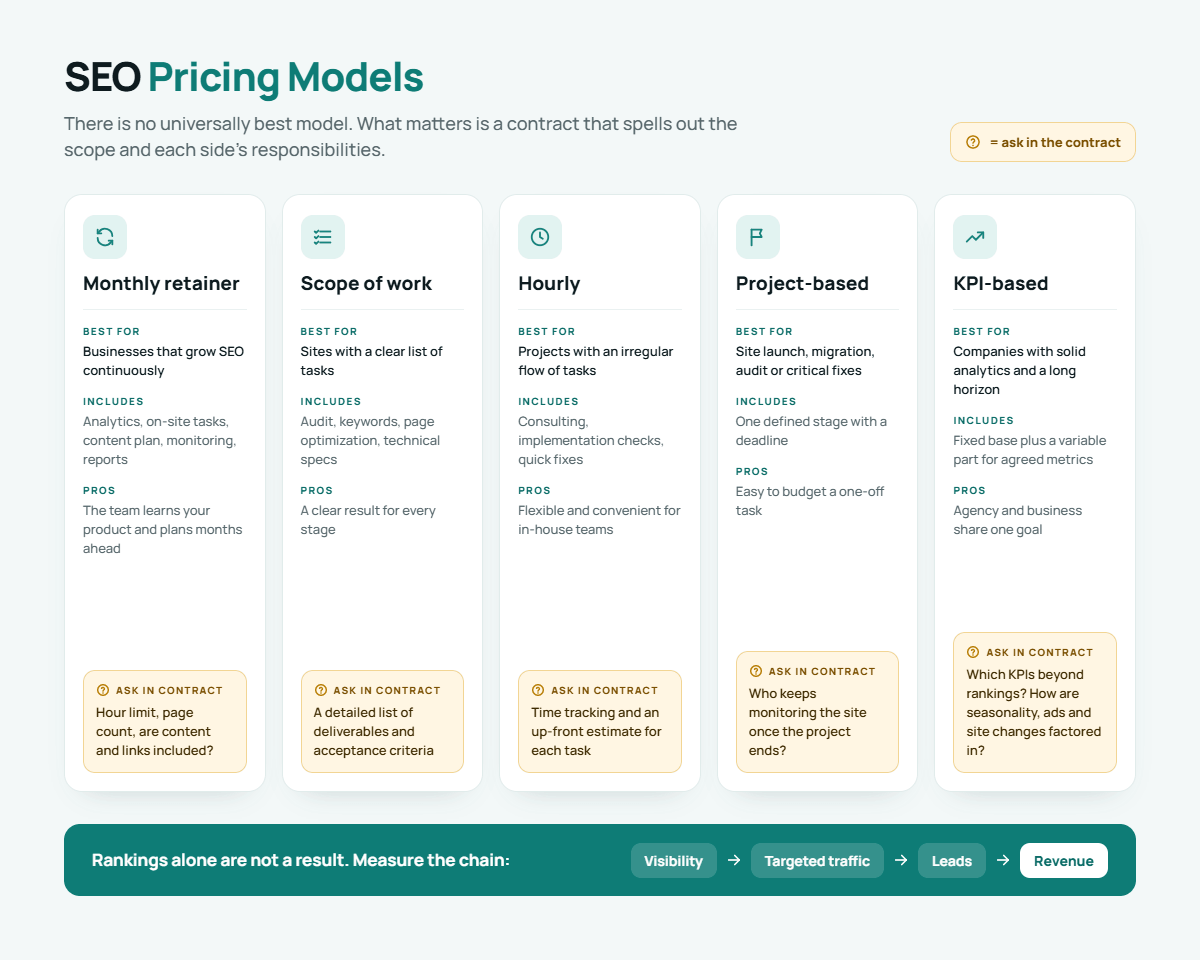
The choice of payment model depends on the maturity of the website, the pace of changes, and whether the business needs an ongoing SEO process or a limited project. There is no universally best model: it is important that the contract explains the scope of work and the responsibilities of both parties.
| Payment model | Best for | What is usually included | Advantages | Risks and contract questions |
|---|---|---|---|---|
| Monthly retainer | Businesses that develop SEO on an ongoing basis | Analytics, website tasks, content plan, monitoring, reports | The team gains in-depth product knowledge and plans work several months ahead | Clarify the hour limit, number of pages, and whether content and links are included |
| Payment by scope of work | Websites with a clear list of tasks | Audit, keyword research, optimization of specific pages, technical specifications | Clear results for every stage | A detailed list of deliverables and acceptance criteria is needed |
| Hourly model | Projects with an unstable flow of tasks | Consultations, implementation reviews, urgent improvements | Flexible and convenient for an in-house team | Request time tracking and preliminary task estimates |
| Project-based format | Website launches, migrations, audits, or critical error fixes | A specific stage with a deadline | Easier to budget for a one-time task | The website will still require regular monitoring after the project is completed |
| KPI-based payment | Companies with high-quality analytics and a long-term horizon | A base fixed fee plus a variable component for agreed metrics | The provider and business focus on a common goal | Rankings alone do not reflect traffic quality; seasonality, advertising, and website changes must be considered |
Payment based solely on rankings may seem straightforward, but it has limitations. A query may reach the top results and still not generate a customer if the page is weak, the price is uncompetitive, or the sales department does not handle inquiries. It is much more useful to evaluate the combination of visibility, targeted traffic, leads, and revenue.
A freelancer is often convenient for narrow tasks or maintaining a small website. An agency can cover several areas of expertise: strategy, technical SEO, content, analytics, and link building. An in-house SEO specialist knows the product well, but may need external developers, editors, or analysts.
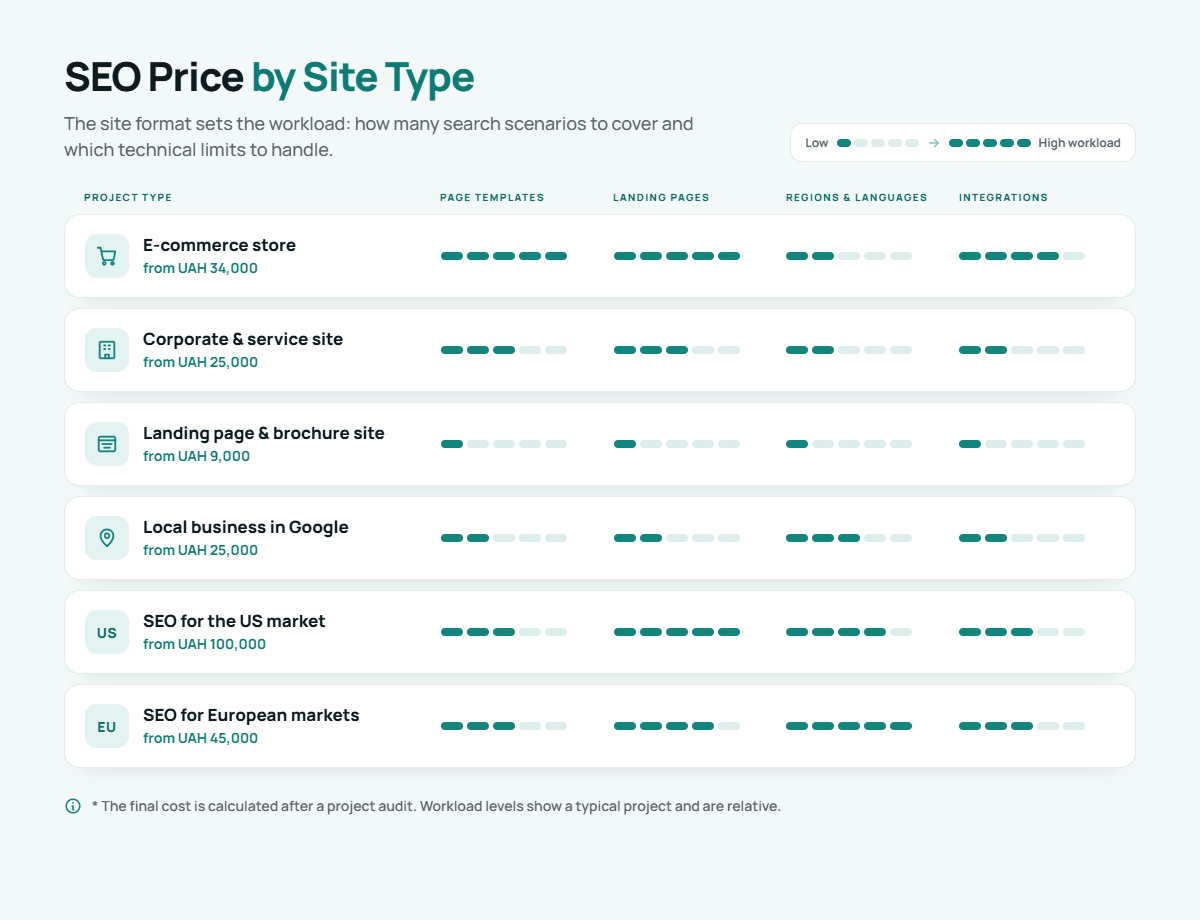
SEO Costs for an Online Store, Service Website, and Landing Page, and Website Promotion in the US and European Markets
The website format sets the scope of potential work, but does not determine the price automatically. The key question is how many search scenarios need to be covered and what technical limitations the project has.
| Website type | SEO price |
|---|---|
| Online store | from $750 |
| Corporate or service website | from $550 |
| Landing page or business-card website | from $200 |
| Local business in Google | from $550 |
| SEO for the US market | from $2,200 |
| SEO for European markets | from $1,000 |
* The final cost is calculated after a project audit
How Much Does E-Commerce SEO Cost?
The cost of SEO for an online store is usually centered around the catalog. The team needs to work on categories, subcategories, product pages, filters, brands, stock availability, pagination pages, and internal linking.
Conditionally speaking, a store with several dozen product listings and a simple structure can be developed selectively. A catalog with thousands of SKUs, product variations, and several language versions requires systematic work with templates. Rewriting every URL manually makes no sense, so the value lies in proper metadata generation rules, filter logic, and duplicate control.
Products that are temporarily out of stock require separate attention. They should not be removed thoughtlessly if the page already attracts demand or has external links. The decision depends on the expected return of the product, the availability of alternatives, and the catalog structure.
The estimate should be checked to see whether development, CRM or product feed integrations, category content, and link-building expenses are included. These items are often what change the total cost of website promotion.
The Cost of Promoting a Corporate Website and Service Website
A corporate website should show what the company does, whom it helps, and why it can be trusted. For SEO, service structure, expert materials, case studies using authorized data, specialist pages, answers to frequently asked questions, and convenient contact options are important.
A business with one service in one city will have a more compact set of tasks. A manufacturing company, law firm, or B2B supplier may have dozens of service lines, industry solutions, technical documentation, regions, and a long sales cycle.
Service website SEO should be connected to lead handling. If the contact form does not work, the phone number is hidden, or a manager replies several days later, organic traffic growth will not generate the expected return. The SEO team can identify such barriers as part of UX/UI recommendations, but implementation depends on the client.
Is SEO Suitable for a Landing Page and a Business Card Website?
A landing page can be promoted in Google if it covers a limited set of closely related queries. A well-prepared page can attract organic traffic for the service name, local wording, and queries with a clear intent to order.
The limitation arises when a business wants to cover dozens of different queries. It is difficult for one page to explain several services, regions, prices, case studies, and product features in sufficient detail at the same time. In this case, it makes sense to expand the website by adding service pages, an FAQ section, useful materials, or separate regional landing pages.
For a business card website, SEO often starts with basic hygiene: correct headings, speed, contact details, a map, a business profile, and a clear service description. This does not turn a business card site into a large portal, but it creates a foundation for further growth.
Promoting a Local Business in Google
For a local business, it is important to be visible where the customer is ready to act: in search, on maps, and in results for a district or city. For a beauty salon, clinic, workshop, or repair service, accurate contact details, hours, business category, reviews, and up-to-date photos matter.
The geography must be truthful. It is not worth creating dozens of empty “service in city” pages if the company does not actually operate there. It is more useful to describe service areas, call-out conditions, service specifics, and real contact information in detail.
To assess the impact, it is worth tracking calls, form submissions, route requests, messages, and inquiries from local sources. Rankings for broad queries show only part of the picture.
The Cost of Website Promotion for the US Market
SEO for the US market requires a separate assessment of competition, language, regions, and audience expectations. The English-language version of the website should be written for the specific market, rather than assembled through automatic translation from Ukrainian or Russian text.
For local demand in the United States, geographic pages, business listings, reviews, and consistent contact details are important. In B2B and e-commerce projects, expert content, high-quality mentions, and technical website preparation for strong competition typically become more important.
The budget grows when a project covers multiple states, works with different services, or competes against well-known domains. The cost of link building in the United States may also be a separate expense, since reliable editorial placements require careful website selection and approvals.
The Cost of Website Promotion in Europe
Europe is not a single market with one language and one set of search results. Promotion in Poland, the Czech Republic, Germany, or other countries should be built around the language, local queries, currency, delivery methods, legal information, and user habits.
For Poland and the Czech Republic, translating the main pages is often not enough. It is necessary to check how users phrase commercial queries, which categories and filters local competitors use, and what people consider important when choosing a product or service.
Link building in European regions also requires a separate budget. What matters is the relevance of the website, audience quality, and the naturalness of placements-not the formal volume of links. Before launch, it is worth agreeing on countries, languages, priority categories, and available resources for creating local content.
How to Calculate an SEO Budget and Avoid Missing Additional Expenses
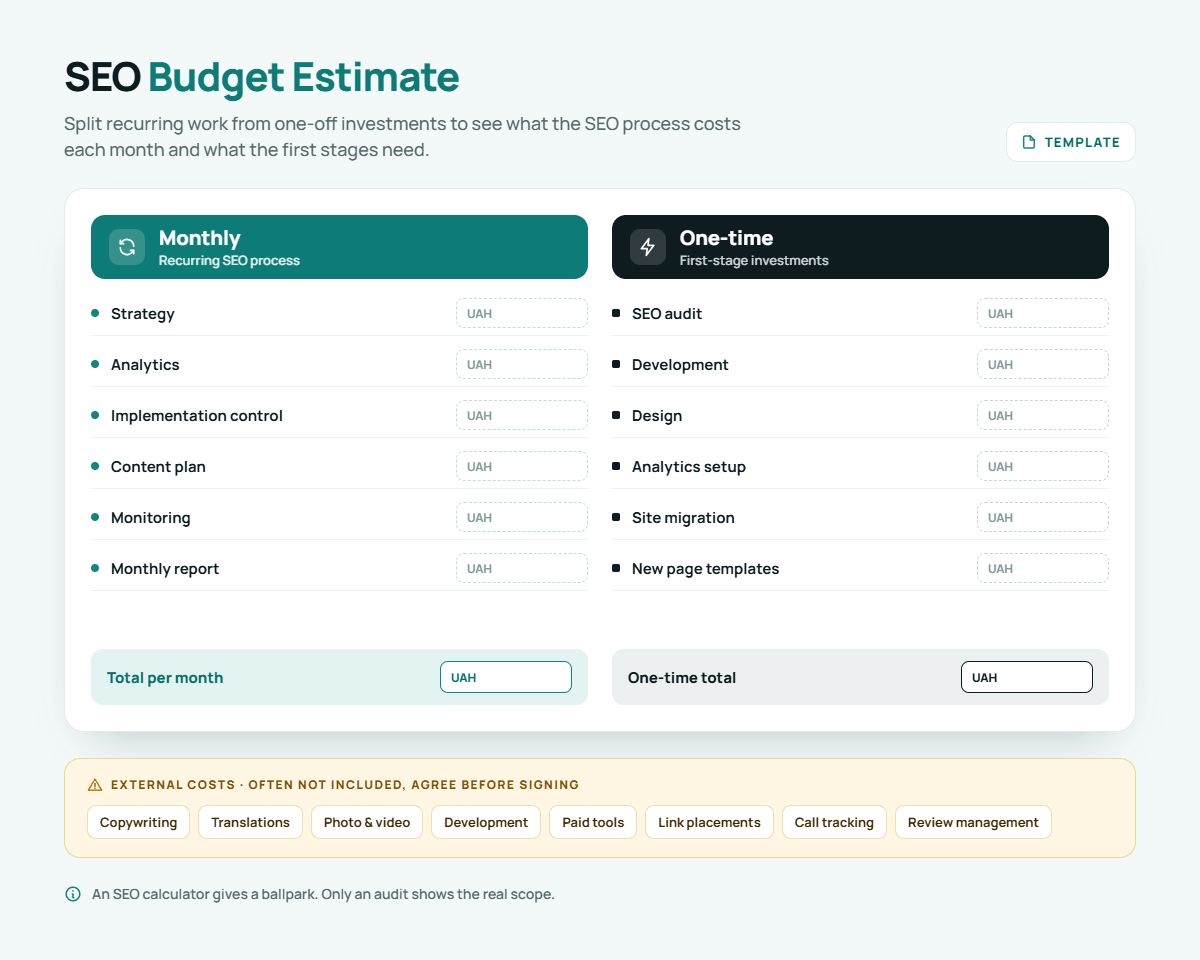
A realistic budget appears after separating recurring tasks from one-time work. This approach helps identify how much it costs to maintain the SEO process each month and what investments will be required during the initial stages.
- Define business goals. Select the services, categories, or regions that are important for sales. If there are many goals, prioritize them based on margins and the team’s readiness to handle demand.
- Prepare the source data. The provider will need access to Google Search Console and analytics, sales data, CRM data, advertising channel information, seasonality data, details on current contractors, and CMS limitations. Access should be granted in compliance with GDPR requirements and personal data protection rules.
- Conduct an initial audit. It will reveal critical technical issues, the condition of pages, visibility, and structural gaps. Based on the results, it becomes easier to understand whether the website needs to be fixed first or whether new landing pages can be developed in parallel.
- Estimate the scope of work. It is important to count not only the number of pages, but also the number of templates, language versions, regions, integrations, and approvals. For one project, optimizing ten key pages may be enough. Another may require building a structure of hundreds of categories.
- Separate expense categories. Strategy, analytics, implementation monitoring, content planning, and monitoring may be paid monthly. Audits, programming, design, analytics setup, website migration, or new template development may be one-time expenses.
- Check external costs. The estimate may not include texts, translations, photos, video production, development, paid tools, link placements, call tracking, and review management. It is better to agree on these items before signing the contract.
- Agree on the reporting format. A monthly report should answer the following questions: what has been done, what has been implemented, what has changed in search, which tasks were delayed, and what is planned next.
An SEO calculator can provide a rough estimate, but it does not replace an audit. A calculator does not know how many duplicates filters have created, how quickly the developer responds, or which categories actually generate profit.
How to Choose an SEO Agency and Review a Commercial Proposal
A low price in a commercial proposal can sometimes mean a limited scope of tasks, no technical support, or generic reporting. It is worth comparing the work included, the level of communication, and the team’s ability to explain decisions in simple language.
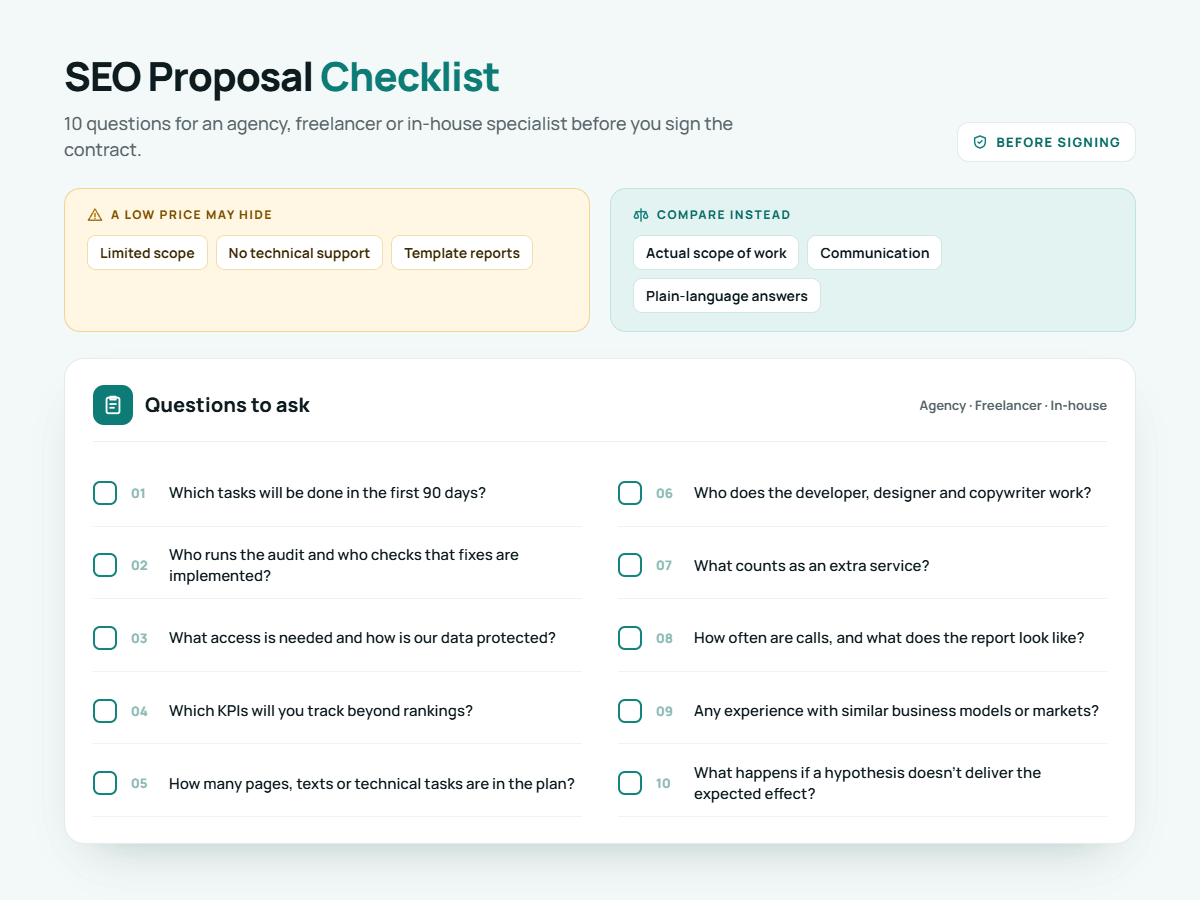
Before choosing an agency, freelancer, or in-house specialist, ask the following questions:
- Which tasks will be completed during the first 90 days?
- Who conducts the SEO audit and who verifies the implementation of recommendations?
- Which access permissions will be needed, and how is data protected?
- Which KPIs are proposed in addition to rankings?
- How many pages, texts, or technical specifications are included in the package?
- Who performs the work of the developer, designer, and copywriter?
- What is considered an additional service?
- How often are calls held, and in what format is the report provided?
- Is there experience working with similar business models or markets?
- How does the agency act if a hypothesis does not deliver the expected result?
Ask to see an anonymized example of a report or dashboard. A good document does not hide difficulties: it shows which recommendations have already been implemented, which are awaiting development, and why these tasks were prioritized.
It is also useful to clarify the approach to links. White-hat link building is based on relevant, high-quality placements without attempts to artificially inflate metrics. The provider should explain how websites are selected and how costs are approved.
At SEOGeeks, we work with comprehensive SEO, audits, SEO during the development stage, keyword research, consulting, white-hat link building, and GEO/AEO promotion for generative answers in ChatGPT, Claude, Gemini, Perplexity, and Google SGE. Our team has delivered more than 200 projects in the markets of Ukraine, Europe, the United States, and Canada. These areas require different resources, so offers should be compared by the scope of tasks rather than by a single line item such as “SEO per month.”
When to Expect SEO Results and How to Measure Returns
SEO delivers a cumulative effect: changes need to be implemented, recrawled by search engines, and evaluated by users. In our projects, the first changes may appear as early as the third month, but the specific timeframe depends on the website’s initial condition, competition, and implementation pace.
Early signs of progress may include fixing indexation errors, growth in the number of correctly processed pages, expanded visibility for target queries, and an increase in impressions in Google Search Console. These metrics are useful because they show movement before a noticeable volume of leads has formed.
For a business, the key metrics are lower in the funnel: targeted organic traffic, page conversion rate, the number of leads, sales, repeat inquiries, and revenue. If traffic has grown but there are no leads, it is necessary to check query relevance, the landing page, prices, the offer, the inquiry form, and the performance of the sales department.
Do not evaluate SEO based on a single ranking on a particular day. Search results change depending on the region, device, search history, competitors, and Google updates. It is much more useful to look at the dynamics of a query group and the share of the organic channel over an agreed period.
Why Demand for SEO Remains Strong and Which Tools Affect the Price
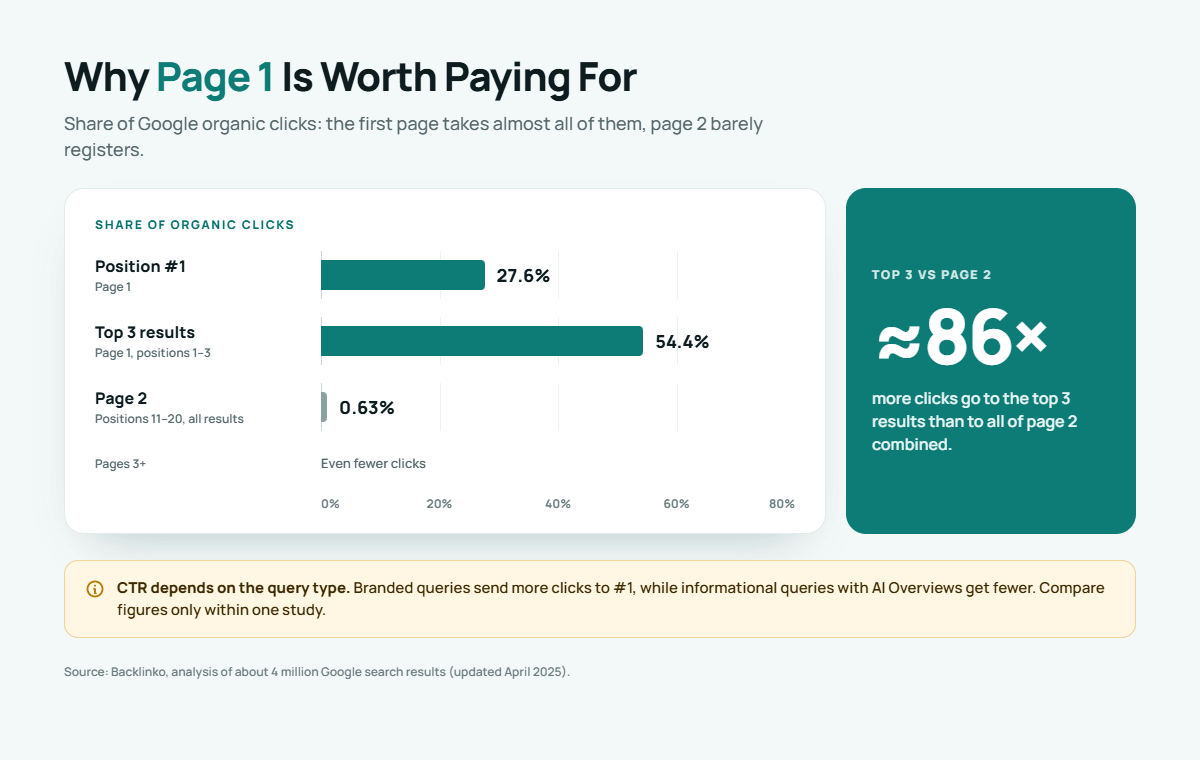
Organic search remains an important channel for businesses because users often come to Google already having a question, a need, or an intention to buy. According to industry research, the first page of Google results receives an average CTR of 71%, while the second and third pages combined receive around 6%. This figure should not be applied to every website as a guarantee: click-through rates depend on the query, search result format, and snippet.
Interest in the question of SEO pricing has existed for a long time. According to Google Trends, the first searches for “SEO cost” were recorded in January 2004, while interest peaked in February 2020. The countries with the highest interest in the query include Bangladesh, Australia, Pakistan, the United Kingdom, and India.
Analytics tools also affect the budget. Google Search Console is available for free and is useful for monitoring indexation, impressions, clicks, and search queries. For more advanced work, teams may use paid platforms such as:
- Ahrefs;
- Serpstat;
- Nightwatch;
- Semrush Keyword Magic Tool;
- Keywordtool.io;
- Semrush Listing Management;
- Georanker;
- content.seogeeks.com.ua;
- AI tools;
- and others.
Tools do not replace a specialist. They help identify a problem more quickly, collect data, and test a hypothesis, but business priorities are still determined by a person who understands the product, market, and project economics.
How Pricing Is Formed at SEOGeeks
At SEOGeeks, we form the budget after reviewing the business task and conducting an initial website analysis. The client receives not an abstract package, but a list of observations that affect the scope of work: indexation status, technical errors, priority areas, structural gaps, competition, page potential, and a list of implementations.
For comprehensive SEO promotion, we determine which recurring tasks the project needs: analytics, keyword research, content, technical specifications, implementation verification, work on off-page factors, and reporting. If a project requires an SEO audit, the result is a list of issues with priorities and recommendations for the client’s team or developers.
We assess SEO during the development stage based on the architecture of the future website, CMS, number of templates, language versions, data migration, and planned catalog. Fixing the structure before launch is usually easier than rebuilding it after hundreds of URLs have appeared in the index.
For GEO/AEO promotion, we assess the quality and structure of content, brand entities, material expertise, clarity of answers to user questions, and technical page accessibility. This area helps expand visibility in AI search, but does not imply guarantees of mentions in ChatGPT, Gemini, Claude, or other system responses.
We confirm current prices for comprehensive SEO, SEO audits, SEO during development, and AI search promotion in an individual proposal: the cost depends on the market, project condition, and agreed scope of work. After the initial audit, the business can make a decision based on specific data-what to do first, which costs are mandatory, which can be postponed, and which metrics should be used to evaluate the result.
If you need such a plan with clear priorities and an estimate, book an SEO consultation.
Current pricing
How much does comprehensive SEO cost?
Pricing for comprehensive SEO depends on the scope and scale of the project. SEO services can be tailored for a small niche eCommerce store or a large marketplace with thousands of products.
SEO Start
$800
- Semantic core (number of pages per month — 15)
- A comprehensive review of the website's structure
- Market analysis (competitors)
- Technical optimization
- Link Building
- Monthly reporting
- Commercial factors / E-E-A-T
- Usability, recommendations for improvement
- Creating mockups for new pages being developed
- Setting up analytics services (Search Console/Google Analytics 4)
- On-page optimization
- Analysis of analysts' reports
- Monitoring rankings for key search terms
- Content briefs or copywriting for landing pages - (10 pages)
- Content briefs or article writing for the blog - (3 articles)
The “Optimal” Package
$1200
- Semantic core (number of pages per month — 30)
- A comprehensive review of the website's structure
- Market analysis (competitors)
- Technical optimization
- Link Building
- Monthly reporting
- Commercial factors / E-E-A-T
- Usability, recommendations for improvement
- QA testing
- Content Manager Position (creating landing pages/posting content on landing pages)
- Creating mockups for new pages being developed
- Setting up analytics services (Search Console/Google Analytics 4)
- On-page optimization
- Working with drop domains
- Analysis of analysts' reports
- Monitoring rankings for key search terms
- Content briefs or copywriting for landing pages - (20 pages)
- Content briefs or article writing for the blog - (5 articles)
- Developing recommendations for local SEO
Enterprise SEO
$2500
- Semantic core (number of pages per month — 45)
- A comprehensive review of the website's structure
- Market analysis (competitors)
- Technical optimization
- Link Building
- Monthly reporting
- Commercial factors / E-E-A-T
- Usability, recommendations for improvement
- QA testing
- Content Manager Position (creating landing pages/posting content on landing pages)
- Creating mockups for new pages being developed
- Setting up analytics services (Search Console/Google Analytics 4)
- GA4 Setup
- On-page optimization
- Working with drop domains
- Analysis of analysts' reports
- Monitoring rankings for key search terms
- Content briefs or copywriting for landing pages - (40 pages)
- Content briefs or article writing for the blog - (10 articles)
- Developing recommendations for local SEO
- Analysis of project logs
FAQ
Answers to frequently asked questions
The cost of SEO in Ukraine depends on the website’s condition, niche, regions, number of pages, and business goals. A small service website usually requires less work than an online store or a project targeting several cities. The exact amount is determined after an audit and agreement on the scope of tasks.
The price differs due to the scope of work, team experience, number of specialists, and whether content, links, analytics, and technical support are included in the package. One offer may contain only basic monitoring, while another may include a full strategy, on-site work, and implementation control.
Programming, design, photo and video production, complex copywriting, translations, link placements, paid tools, and end-to-end analytics setup are often charged separately. Before starting, ask the provider to specify in writing which expenses are included and which require separate approval.
Yes. With a small budget, it is worth focusing on priority pages, critical technical errors, and local demand. This approach will not allow you to quickly cover a broad keyword range, but it helps direct resources toward services or categories with the greatest sales potential.
The cost of online store promotion depends on the catalog size, number of categories, filters, product pages, language versions, and the platform’s technical condition. In addition to the monthly SEO budget, template improvements, feed work, category content, and expenses for quality links may be required.
SEO expenses pay off when revenue or gross profit from organic leads and orders exceeds promotion costs. Evaluation requires properly configured goals, CRM data, and an understanding of lead value. Ranking and traffic growth are useful, but by themselves they do not show return on investment.
Analysis is needed to identify the real tasks: indexation errors, duplicates, structural problems, the number of priority pages, and development requirements. Without this information, an agency can only provide a rough estimate. A detailed estimate allows the client to understand what actions they are paying for and in what order they will be completed.
In the short term, paid search advertising can often be launched faster, while SEO requires time for implementation and the accumulation of results. In the long term, you need to compare the cost per acquired lead, traffic quality, and the contribution of each channel to sales. In practice, SEO and advertising often work together.
For a new website, the budget usually includes preparing the structure, keyword research, technical requirements, page templates, and content. If SEO is involved during the development stage, some future rework can be avoided. The price depends on the number of services, categories, regions, language versions, and the selected CMS.
A responsible agency does not guarantee specific rankings or traffic volume because search results depend on Google algorithms, competitors, and client actions. Instead, you can establish a transparent process: scope of work, reporting timelines, KPIs, implementation procedures, and regular performance evaluation.
You can promote a website yourself if the team has time to study SEO, implement changes, and analyze data. The minimum set includes Google Search Console, analytics, and website audit tools; some services are paid. The main risks are incorrect technical changes, duplicate pages, and wasted time on tasks without a commercial impact.
Yes, the price may change if the geography, product range, number of language versions, or volume of technical work expands. New tasks discovered after an audit or website migration can also be a reason. A transparent contract provides for approval of additional work before it begins, rather than unexpected invoices after the fact.

Article author
Sergey Slibezun
CEO & Co-Founder SEOGeeks
Co-founder and CEO of SEOGeeks. Responsible for agency strategy, client communication, and the business outcomes of SEO projects across Ukraine, Europe, and the US.